









Best Time To Visit the Falkland Islands
Most visitors to the Falkland Islands time their trips to coincide with the Antarctic season, but the islands offer great wildlife experiences throughout the austral summer.
Discover More
The following trips include time exploring the Falkland Islands as part of a longer voyage including South Georgia & Antarctica
Price Match Promise - We’ll match any price you find elsewhere for the same trip
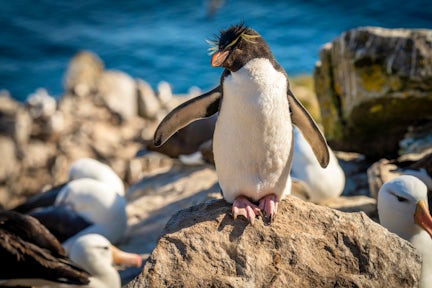
A rockhopper penguin surrounded by black-browed albatross at West Point
If Falklands Islands vacations were easier to get to we have no doubt they would receive significantly more visitors each year. For birders in particular the islands are a fantastic destination: there are 227 recorded species here, with 59 regular breeders and two endemics to cross off the life list, including the Falkland steamer duck.
The change to see up to four of the world’s penguin species is also a major drawcard. Gentoo, magellanic, rockhopper, and king penguins are all found here. The chance to see groups of resplendent kings marching along empty white beaches is unique to the Falkland Islands and makes for truly great photo opportunities. Whales and dolphins are a common sight offshore and there's always the chance of seeing lazing sealions or giant elephant seals hauled up on the beaches.
What makes the Falklands wildlife so special is how accessible it is. Many species have no fear of people and it’s far from uncommon for the patient observer to be approached by a curious penguin or inquisitive caracara, making for some unforgettable wildlife encounters during Falkland Islands cruises.
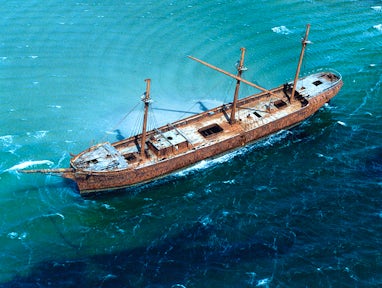
The wreck of the Lady Elizabeth near Stanley
The Falkland Islands have a long and frequently contested history. The unoccupied islands were first claimed by the British in the mid-18th century, but France and Spain both looked to exert their claims to the islands at different times. To this day the islanders remain fiercely loyal to the British crown, but Argentina has consistently maintained a claim to sovereignty to the islands that they continue to this day. In Spanish the islands are known as Las Malvinas.
In the middle of the 19th century Stanley was briefly one of the world’s ports as a stopping point on the trade routes between the Atlantic and Pacific around Cape Horn. At different times the islands made their living from whaling and sheep farming in relative obscurity until the 1982 war thrust them into the world spotlight.
While peace has long returned to these sleepy islands, vestiges of that time are still visible and many islanders still have their stories from the war – while having their faces set firmly to the future.
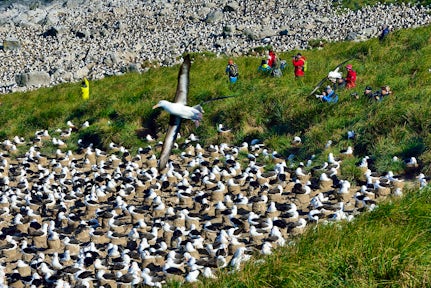
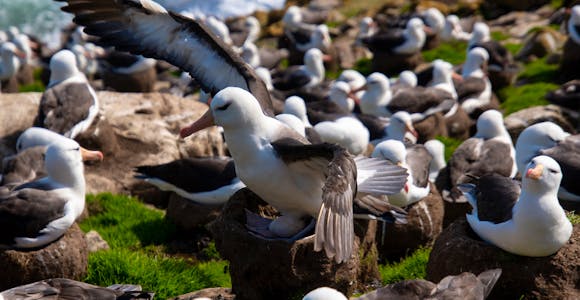
The Falkland Islands are home to many black-browed albatross colonies
Which exact locations you visit in your cruise to the Falkland Islands depends on the weather, season and ship itinerary, making it impossible to guarantee where you’ll land. The only exception to this is Stanley: except under unusual circumstances ships will call in here for essential immigration checks.
From the extraordinary black-browed albatross colonies at West Point and New Island, there are some amazing places to see seabirds. For penguins, Carcass Island is famous for its magellanic colony, while there is the chance of seeing four species in one landing at Saunders Island. Bleaker Island is noted for its rockhoppers and sealions.
Taking a break from the wildlife, Stanley is a fascinating place to explore with its history, beautiful cathedral and traditional British pubs, as well as offering the chance to see shipwreck and visit nearby Gypsy Cove with its magellanic penguins.

The Falklands Islands offer some amazing wildlife experiences that you just won't find anywhere else on the planet. They're so much more than just an extra to add on to a South Georgia and Antarctica cruise.
Cassia Jackson Antarctica Specialist
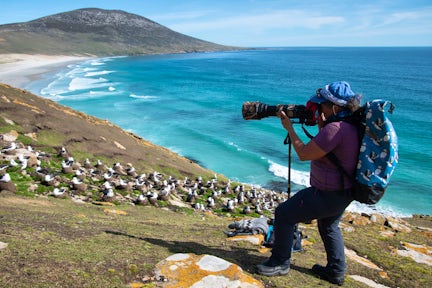
It's possible to experience all four seasons in a day on the Falkland Islands
The visiting season for the Falkland Islands corresponds with the austral summer, runs through the austral summer months from the end of October to late March. The islands have a cold maritime climate, although it is far milder when compared to Antarctic temperatures.
Visiting at this time you can expect to see flowers in bloom such as the bright yellows of the island’s iconic gorse. This is also the time when animals breed, so depending on when you visit you have the chance to see penguins chicks, albatrosses on the nest or baby sealions.
Daytime temperatures during the summer season are typically around 50–55ºF (10-13ºC). Within this there can be tremendous variation, from light snow flurries to sunny days when a t-shirt is all you need. The only truly constant factor is the weather’s unpredictability.
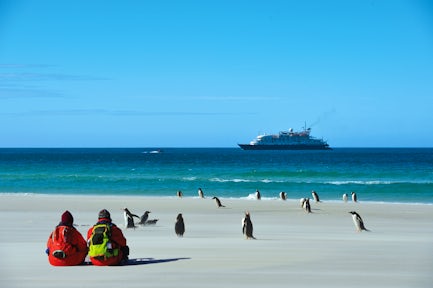
With gentoo penguins on a Falkland Islands beach
The Falkland Islands are typically visited as part of a longer cruise visiting South Georgia and the Antarctic Peninsula. These are once-in-a-lifetime trips so finding the right voyage is crucial, so you'll want to carefully consider both the itinerary and the type of ship as well as your travel dates.
The Falkland Islands trips scored 4.6/5 from 428 reviews
We loved every minute of it, just wish we could have spent a bit more time in Stanley, it looks so delightfully colonial like belonging to another age.
Travelled: January 2018
Lucien & Marie-Eve - South Africa
Price Match Promise - We’ll match any price you find elsewhere for the same trip
Price Match Promise - We’ll match any price you find elsewhere for the same trip
The visitor season on the Falkland Islands typically runs through from October to April. The more favourable months are November to February when the weather is clearer and average temperatures are around 8 degrees centigrade/ 46 fahrenheit, although the weather is still very changeable.
Most people visit the Falkland Islands on an expedition cruise ship in conjunction with a visit to South Georgia and the Antarctic Peninsula. The islands take around a day and a half to reach from Ushuaia in Argentina, the main departure port for cruise ships. It is also possible to fly from Chile.
There is a weekly flight to from Punta Arenas in Chile to Mount Pleasant near Stanley. The flight departs every Saturday. It is also possible (if more complicated to arrange) to fly direct to the Falkland Islands from the UK on a service operating from RAF Brize Norton.
In general, cruise ship visitors don’t require a visa for Falkland Islands or to participate in shore excursions. However, visitors arriving by air, or intending to spend time in the Falkland Islands before or after a cruise, may need a visa. If you hold a passport for the USA, Canada, EU countries, Australia or New Zealand and most Asian and South America countries then no visa is required.
Most visitors to the Falkland Islands time their trips to coincide with the Antarctic season, but the islands offer great wildlife experiences throughout the austral summer.
Discover More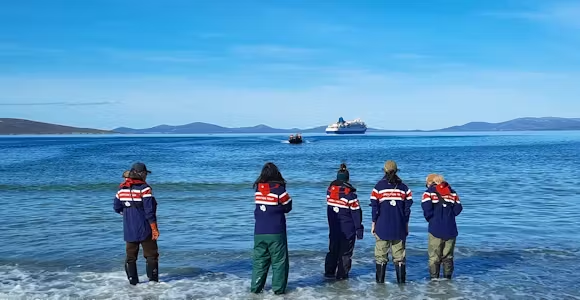
Most people arrive in the Falkland Islands by expedition cruise ships but there are a small number of flight options for those looking for a fly-sail cruise.
Discover More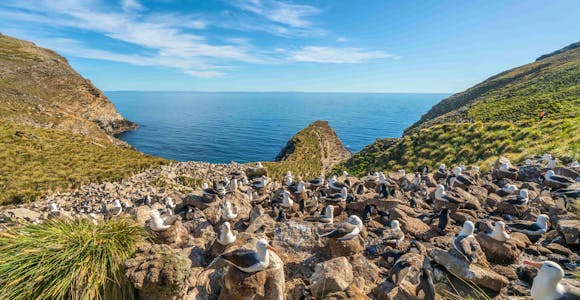
The Falkland Islands are a great wildlife watching location and are home to both sub-Antarctic species and those from mainland South America.
Discover More
The human history of the Falklands Islands barely stretches back more than a handful of centuries, but these tiny islands have packed a lot into that time.
Discover MoreFor sheer density of wildlife, majestic scenery and riveting history, South Georgia is a truly world-beating destination. Known as the Serengeti of the Southern Ocean, it’s one of the least visited places on earth – and offers great rewards for those who make their way to its shores.
We'll spend some time listening to your aspirations, then discuss the kind of experience that might suit you.
Next we'll discuss the options, shortlist the best trips for you and present you our impartial recommendations.
We'll place a 24 hour hold on your preferred option - without obligation - whilst we talk through the details.