For those of us living in the northern hemisphere, the approach of summer is all about taking things easy and relaxing into thoughts of a nice holiday – perhaps somewhere hot, with a beach. Down in the southern hemisphere, the seasons are reversed, and Antarctica sleeps in the freezing darkness of the austral winter. Only the emperor penguins are tough enough to spend this time huddled out on the ice, raising their chicks in the most extreme environment on Earth.
Well, almost. Every year, a small number of people get to overwinter in Antarctica, keeping the lights on in the handful of research bases dotted around the continent. Before I joined Swoop, I was lucky enough to spend the winter working at Rothera research station for the British Antarctic Survey (BAS). Here’s what it’s like to overwinter in Antarctica, when the sun disappears below the horizon and doesn’t rise again until the coming of spring.
Preparing for the Antarctic winter
Rothera is the British Antarctic Survey’s largest research station, on Adelaide Island in the western Antarctic Peninsula. It’s a great place to live because the Peninsula has such dramatic landscape. It has rocky hills and mountains as well as snow and ice, and there’s plenty of wildlife. I spent three summers there in total as a station support assistant – one of a big team who keep the place running so that the scientists can do their research.

The station is constantly moving during the summer months. It’s served by ship but also with an airstrip, an important transit and refuelling point for people heading further into the continent, whether for BAS staff, people from other national Antarctic programmes or even the start up team from Union Glacier, who pass through every spring to get their camp ready for travellers visiting the Antarctic Interior. Researchers, sailors, pilots, and transit crews all mix together in the bar or dining room before continuing on their journeys. It’s a long way from Britain’s first base at Port Lockroy (now known as the Penguin Post Office) or the spartan ‘waiting room’ at the equally historic Damoy Hut.
At the height of summer there are about 160 people living at Rothera, plus everyone in transit. The end of the Earth can be surprisingly busy! But as winter approaches, the population slowly begins to shrink, until the last summer residents pack their bags and depart on the last ship of the season.

Rothera has a great tradition for those leaving on that last ship. As it pulls away in the twilight, the overwintering team all stand together on the wharf and light flares to send them off. It’s a really emotional scene when you’re waving over the ship’s bow rail, looking at Antarctica fade away in a smoky red glow, but I always wondered how it would feel to be one of those being left behind, watching the ship disappear into the gloom as the flares burned themselves out.
When I was offered a job as winter station general assistant, I finally got to find out.
What is it like to overwinter in Antarctica?
It’s a strange sensation watching the last of your colleagues sail into the darkness, knowing that your physical isolation is now total. Of course, being British I quickly learned that the first thing you do is go inside and make a cup of tea. A classic coping mechanism when faced with a big challenge.

And in truth, things don’t initially feel very different. After a month of the station becoming increasingly quiet, there’s even a sense of new purpose, now it’s just the wintering team left, you can finally concentrate on the tasks at hand. If it doesn’t feel like a hardship, that’s because Rothera is a pretty comfortable place to call home: it’s warm enough to wear a t-shirt inside, there’s a full dining room and bar, and a big TV room with a projector and Playstation. There’s no suffering like Shackleton here.
Dealing with what’s outside is the biggest challenge: the cold, the wind and the darkness. A lot of my winter job was spent outside with a shovel, managing the entrances and exits to the building. It’s very important for safety as well as general access: the windows in our rooms serve as fire escapes, which is a constant issue when the wind keeps funnelling snow drifts as high as the roof of the building. If you don’t keep on top of things, you find yourself having to dig a tunnel to the windows and doors.

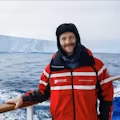
Summer temperatures on the Antarctic Peninsula are quite mild, as they hover just above freezing during the daytime. But when there isn’t any daytime, the cold becomes absolutely brutal. When I was working outside, it would take less than five minutes to get the classic polar explorer’s ‘frozen beard’ look.
It was worse when I started sweating from clearing snow and went inside to cool down, only for my shirt to get damp and freeze the moment as soon as I stepped outside. This is the unglamorous side of Antarctic life – even transferring kit and waste across the station on the back of the skidoo can be physically taxing in the dead of winter.
Midwinter messages from the BBC
Rothera is just a degree south of the Antarctic Circle, which means that in winter, there’s a state of permanent twilight rather than the absolute black night that you get at the South Pole. But you don’t realise quite how much you miss the sun until it’s gone. The lack of daylight creeps up on you slowly, no matter how many times you enjoy the beauty of the Southern Lights. I honestly thought it didn’t bother me for quite some time, until I realised I was becoming snappy with people, and others were doing the same.

This was definitely the most challenging part of overwintering, and it lasted about six weeks. You can tell with the lack of the day-night cycle, everyone is tired because they’re not sleeping very well, and time seems to go very slowly. This makes the Midwinter celebrations on June 21 special. It’s our Christmas – a time to celebrate but also to look forward to the sun’s return.
Midwinter is a week’s holiday, where all work on the station stops, apart from essential services. We plan activities like a jog on the runway, or a mini-Olympics tournament, and screen the classic Antarctic horror movie The Thing. There’s plenty of time to chill out and relax before we all gather for our big Midwinter’s meal. The chef is very impressive – by the time we sit down it’s been months since we had a delivery of fresh food.

But the real highlight comes after the meal. We have an Antarctic version of ‘Secret Santa’ where we give gifts to each other. The catch is that you have to make the gifts yourself using only what you have to hand on the station. It’s super cool because you never realise how creative you are until you’re in that situation. People get really inventive, coming up with things from wood, metal, old plumbing, ropes and clothing – anything goes really!
After gift-giving, we go to the operations tower. Every year the BBC do a special live broadcast for the overwintering team. When I was there, it was from Cerys Matthews on 6 Music. It’s really lovely that there are recorded messages from family throughout the radio broadcast, and hearing the collective thoughts and love from family from so far away is a very emotional moment in the tower.
The Antarctic Film Festival
After midwinter, there’s a renewed sense of optimism. The sun is still a way from returning, but you know you’ve got through the hardest part.

In August, there’s also the Antarctic Film Festival to look forward to. All stations with overwintering crews are invited to take part: you get 48 hours to make a 5-minute film, which has to feature a nominated sound, an object, a character, an action and a quote. It’s always a madcap adventure, and like the Midwinter’s gifts, it’s a great creative outlet, as well as a chance to build community with our fellow overwinterers elsewhere on the continent. For some reason, the Australians always seem to excel at this, though I’m proud that Rothera finally took home the prize for best film (and best acting!) in 2025.
By the end of the season, you can start to smell spring in the air. It’s an enormous celebration when the first sliver of sun rises above the horizon. Once you get into September, you know things are changing because the local Weddell seals start to give birth. Life is returning.
It’s also underfoot. One of my favourite memories was walking out onto sea ice. Knowing that there are maybe 70-80 metres of water below you is a strange feeling, but it takes a surreal turn when, out of nowhere, the whole landscape starts to sing around you. Old polar hands know it well, but for a first time overwinterer it’s truly startling, as you realise that what you’re hearing is the sound of seals beneath the ice, singing and communicating with each other. They sound like cosmic aliens – like nothing I’ve ever experienced.

At the end of winter, when the first flights appeared on the schedule, that surreal natural music felt like an essential part of my experience. Wintering in Antarctica is full of strange moments like this – unexpected beauty coming out of the most challenging of landscapes. My winter as part of one of the smallest and most isolated communities on the planet was one of hard work, creativity, and tradition during the longest nights it’s possible to experience.
The warm feeling of the spring sun on my face was an unimaginable treat after such a winter – but if you asked me if I do it again, I’d sign up like a shot.
*