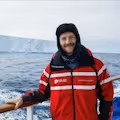
At Swoop, we spend a lot of time talking about expedition guides as being the rockstars of Antarctic expedition cruising. It’s true they’re the best in the business for helping you experience the White Continent up close, but they’re only part of what makes a cruise here so special. Much of the credit also has to go to the ship’s crew and its captain, who work tirelessly behind the scenes to take travellers around Antarctica in comfort and safety.
Safely operating a ship in polar waters presents some unique challenges, from extreme weather to ice and whales. To find out how they do it, we sat down with William Bennett. Senior Director of Marine Operations for Quark Expeditions, who operate some of our favourite Antarctic cruise ships, including Ultramarine, World Explorer and Ocean Explorer.
How did you first start working on ships in Antarctica?
I started working at 18, graduating from the Coast Guard College in Canada and working on Coast Guard ships for about 20 years. I’ve worked on tankers and large cruise ships like those you see in the Caribbean, but it was after I got my Master Mariner certificate that I had my first opportunity as captain on an expedition cruise ship.

I got hooked on it and I still am. I’ve now found myself in both Antarctica and the Arctic for the last 20 years. It’s the greatest segment of the industry for a seafarer to be in. You’re not lugging cargo on a schedule, you’re going to the most pristine places where the real geography is.
How are today’s modern expedition cruise ships equipped to deal with the challenges of Antarctica and the Southern Ocean?
Every commercial ship has to have a standard set of equipment—GPS, radar, depth sounders and so on— but for polar operations, ships need to be specially designed and built with additional equipment, and operated by people trained for polar conditions.

In addition to regular radar, we use ice-detecting radar at a special frequency that can detect ice even when it’s low on the surface. We also use high-power searchlights, because in the darkness of the Antarctic night, you can’t rely on radar alone.
Not all of Antarctica is perfectly charted, so we have forward-looking sonar, which allows us to look under the water ahead of the ship to spot hazards. There’s also OLEX, which is a crowdsourced track database. Ships operating in polar areas automatically log sea depth and position data. This data is uploaded to the cloud and shared among vessels, so even if a place isn’t officially charted, we’re passively charting the area as we travel.
Antarctica’s defining feature is ice. How do cruise ships operate safely around it?
We monitor the ice via satellite imagery to help us determine whether an area is safe to go to. In the spring there’s usually much more ice that’s still breaking up, which makes for slower and more cautious navigation. As the season progresses and temperatures rise, the ice coverage decreases. Then as we move into the fall, we have the opposite: less daylight, lower temperatures and increasing ice, so we adjust our operations accordingly.

Ice is both a danger and an attraction. We want to get close – but never too close. It’s important to remember that icebergs are mostly submerged, and when they roll or calve, they can create big waves. We always keep a safe distance.
We use trained bridge officers to spot ice day or night, and if we’re transiting and encounter old, thick ice, we’ll reduce speed to a safe level. But all expedition cruise ships are ice-strengthened. Our ships are Polar Class 6, and are designed to operate in first-year ice that’s up to one metre thick. We can move through that at about four knots. But safety is always a combination of the ship’s build and speed. Even a strong ship can be unsafe at high speeds in ice.
How do you navigate safely in areas with large numbers of whales?
Bridge officers are trained through the International Association of Antarctic Tour Operators (IAATO) in identifying marine mammals and knowing where they’re likely to be, so we can avoid collisions.

I also sit on IAATO’s Marine Committee. We helped implement geofencing in high traffic areas along the Antarctic Peninsula. These zones have a speed limit of 10 knots to reduce the risk of potential whale collisions.
How do you work with the Expedition Leader to create the best itinerary for travellers?
There’s no fixed itinerary – that’s what makes it amazing for the passengers, and it’s what I love about this industry. We go where the wildlife and geography are.
We always begin with intelligence from the last voyage, and study satellite imagery for ice conditions to make a rough plan. As we cross the Drake Passage, our Expedition Leader will be talking to their counterparts on other ships, finding out where the wildlife is or isn’t appearing, what’s happening with the glaciers, the penguins and so on, and we’ll adjust our plans according to that.

We’ll also adjust our plans based on the weather. We can go to one of the best places and then find it completely blown out because there are katabatic winds coming down off the mountains without warning.
Plans are made weekly, daily, and then minute-by-minute. A plan might be in place, but if the wind suddenly makes a landing unsafe, we’ll change plans immediately. Likewise, if calm weather unexpectedly opens up a landing, we can take advantage of that as well: we’re very nimble and we always prioritise experiences. If the hotel staff have prepared an amazing dinner but all of a sudden we’re in a pod of orcas, all bets are off. We’ll stop the ship and dinner can wait.
I’ve been sailing on ships for 40 years and I have never gotten tired of a whale sighting. I’ll stay at a whale sighting until the whales go away.
People visit Antarctica for its pristine environment. How do expedition cruise ships minimise their environmental impact?
The first thing is that heavy fuel is banned. That’s the stuff you’ve seen in the news when a tanker sinks and it pollutes the bottom and persists for years. The ships use light diesel fuel, like what you’d see in a truck or a car. Ships also have a double-bottom arrangement, so there’s a protective space between the outer hull and the fuel tanks.

We also have a ballast water treatment system. There’s a potential problem with invasive species where a ship takes on ballast water in one and pumps it out somewhere else. So we use a ballast water treatment system which kills any organics that might be present, to eliminate the risk of accidentally transferring invasive species from one ecosystem to another.
The bottom of the ship’s hulls are also coated with an antifouling paint to stop marine growth on the hull being transported elsewhere.
For sewage, there’s an onboard treatment plant. Our black water goes through an anaerobic biodegradation process with UV light and oxygenation. By the time it’s treated, it’s just clear water – and when you’re down in Antarctica, none of that is even released at all. We only do that when we’re a certain distance from the coast. There’s a zero-tolerance policy for any kind of waste going overboard – no garbage, not even a piece of gum.
Finally, when we stop in a location, we use dynamic positioning. Previously you would drop anchor, but that can drag over the seafloor and potentially damage it. Dynamic positioning systems mean we can hold the ship in position without putting the anchor down.
Travellers to Antarctica talk a lot about the Drake Passage. How do you handle crossing this famous body of water?
The Drake Passage between the tip of Argentina and the Antarctic Peninsula is part of an open body of water that runs all the way around the bottom of the planet. Energy that’s generated from a storm 500 miles away doesn’t get broken up by a mass of land – it just keeps going So when you get the energy from multiple storms colliding plus the local weather as well, it can really pile up the waves.

That said, it’s completely manageable. We have the benefit of accurate weather forecasting so we know very well when systems are coming through and how bad they’ll be. That means we can manage any kind of weather – it’s just a matter of how much comfort you want. With ship stabilizers and modern stability calculations, it’s a relatively comfortable passage.
Usually it doesn’t last more than a day. It’s a two-day crossing, and even in the worst storm, it’s usually just one rough day. Often, we don’t have any bad weather at all.
Passengers hear so much about the Drake Shake, they often want to experience it. People sometimes seem disappointed when they don’t get a good thrashing on the Drake! But safety always comes first. If it’s too bad, we’ll delay the crossing or go early to avoid the worst of it.
Finally, you’ve been working in Antarctica for 20 years. What makes you keep coming back?
It’s the mystique of such a remote place that very few can get to. There’s a big aura around the name, and when you’re actually there, it lives up to it. You can see a perfectly white pristine glacier and realise that there’s no one else around for hundreds of miles, but there’s life all around you from seals and penguins to whales. You hear the cracking like thunder as a glacier breaks and calves. It’s always cracking, always moving. And you realize: we’re the only ones hearing this right now. Look where we are.
It’s mysterious, it’s alluring, and it still does it for me – every single time.
*