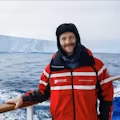
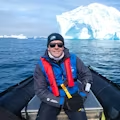
Every April 24, we celebrate Antarctic Ambassadors Day, which is an opportunity to celebrate one of the most extraordinary places on our planet – as well as inspiring people to take steps towards protecting a destination where environmental changes can impact us all.
To learn more, we spoke to Steve Jones, Chair of IAATO’s Antarctic Ambassadorship Committee and Director of Fundraising & Operations at whale and dolphin conservation organisation ORCA.
What does it mean to be an Antarctic Ambassador? Do you have to go to Antarctica to be one?
Ambassadorship isn’t just about people who go to Antarctica – it’s about everyone who cares about protecting Antarctica, and wants to make changes in their life, big or small. Collectively, those changes can have a bigger impact than you think on protecting the White Continent that we all love.

You don’t have to have travelled to Antarctica to be an ambassador for it. We know that most people in the world will never have the chance to go, and that it’s the actions of this majority that can have the biggest impact on a place that’s so vital for the health of our planet.
Ambassadorship is really about accepting that you love and care about Antarctica and that you want to make a change and play your part in helping keep it safe.
What are some of the acts of ambassadorship that anyone can do?
IAATO talks about the 10 simple acts of ambassadorship that people can do to start conversations about the environment. That can be as easy as writing a social post about Antarctica and why it’s important to protect it, to making decisions not to use single-use plastics or switching to green cleaning products with refillable bottles that are less impactful on the environment. Reducing the amount of meat that you eat – being meat-free for a month – is a huge thing when it comes to the climate and having conversations about climate change. A lot of it is about having local impacts as well as bigger ones, like going on a beach clean or taking part in a citizen science project.
Does ambassadorship extend to how IAATO provides guidelines for ship operators, and how they talk about Antarctica and the environment with their guests?
Absolutely – we’ve embedded ambassadorship into our bylaws. IAATO is a membership organisation, and we all have a shared common purpose in being responsible tourist operators, and being stewards for Antarctica. It’s a big opportunity for us, and there’s a lot that we do on a practical level, such as implementing the biosecurity measures that all operators follow, or geofencing parts of the Antarctic Peninsula with speed limits to mitigate the risk of ship strikes with whales.

These are all operational, but they’re also all really profound parts of being ambassadors. But one of the other key things we do is to provide resources and tools to support operators, so that they can talk to the tourists they take to Antarctica and take them on a journey towards becoming ambassadors.
This is our Antarctic Ambassadorship Expedition Programme, which we developed to help guides teach their guests – including about how to have conversations about difficult topics like climate change. This is available to all IAATO operators and is carefully designed to give a really good overview of what sort of questions that guests might have, while also being flexible enough to be used for a wide range of audiences travelling on different styles of ship.
This season we completed the newest phase of pushing out these resources, and they’ve proved really successful. We’re proud of the number of expedition teams and guides who are embracing them, and now we’re looking at how to spread these resources even more widely.
When we talk about acts of ambassadorship, we’re usually talking about things that individuals can do. But there’s a great opportunity for every IAATO member to do something operationally. And that goes all the way up to how we look at emissions, the way we route ships and the future for using alternative fuels.
Can you tell us about the work you do at ORCA that might inspire others to become Antarctic Ambassadors?
ORCA has been working in the Southern Ocean since 2018, with the British Antarctic Survey (BAS), the Government of South Georgia & the South Sandwich Islands (GSGSSI) and the cruise operator HX Expeditions. We’re involved with the Sustained Monitoring Project, which looks at the distribution of large whales around South Georgia. You have a relatively unique situation there, because South Georgia is one of the few places in the world where cruise ships make up pretty much all of the traffic in the coastal waters. There’s a concern that humpbacks, southern right whales, and also recovering Antarctic blues and fin whales, are being seen in areas that ships are sailing through, bringing an increased risk of ship strike.

Being killed by being hit by a ship is one of the biggest threats that large whales face globally. Over the last four years, we’ve worked with HX to put teams of trained volunteers on MS Fram to do distant sampling surveys, so we can look at where the whales are found and at what densities, whether there is any seasonality and so on.
The project has been really successful, and it also shows the power of citizen science. We’ve had volunteers from all different backgrounds and walks of life going to one of the remote places in the world, to collect data that’s now being used to inform conservation management measures across South Georgia and its waters around it, as well as down to the Antarctic Peninsula.
It’s having a really profound impact. The whale density maps have been used by the GSGSS to bring in voluntary speed restrictions that cruise operators stick to. We’ve also had some really exciting findings, such as the first photo ID of a blue whale returning to South Georgia, suggesting there are whales coming back specifically to South Georgia each year – possibly even a resident population.
How does ORCA work with expedition teams in Antarctica?
We developed the OceanWatchers digital citizen-science platform, which is an app to work with IAATO’s Voluntary Cetacean and Pinniped Sightings (V-CaPS) Program. This collects critical data on whales and seals and has helped IAATO develop best practices to reduce our impacts on wildlife.
We’ve had ocean conservationists embedded with expedition teams doing education and data collection with guests, and we also do bridge crew training for the Southern Ocean, where we teach the crew on how to avoid ship strike. Ultimately, we have the expedition teams collecting data, volunteers going on the bridge of the ships, and our own people teaching guests how to collect data on the ships. It’s all real time feedback that we can put into our data sets to use in training and policy to reduce the risk of collisions.
People like these are all lucky enough to have visited Antarctica and know what an incredible place it is. From an IAATO perspective we know that alone can inspire people to be ambassadors. It doesn’t have to be complicated. Even small acts can make a difference, because every one of us has the power to be part of that change – and to inspire others.
*